What symmetry group is a brick wall? Bonds and parquet, classified
The wallpaper group of every common brick bond and parquet layout — running bond, stack bond, herringbone, basket weave, Flemish bond — with diagrams and the reasoning.
Brick walls and parquet floors are the best place to learn the wallpaper groups, because the same rectangular unit laid four different ways gives four different groups. Here are the common bonds, assuming identical bricks and ignoring color and texture.
Stack bond — pmm

Running (stretcher) bond — cmm
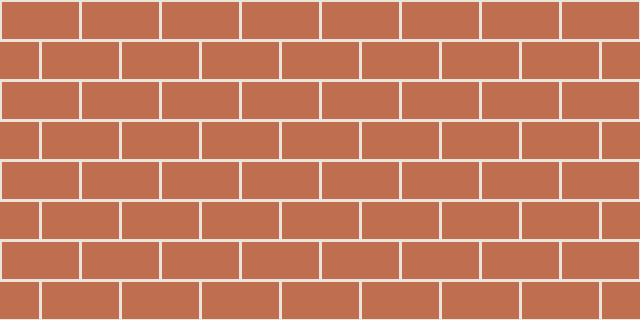
Flemish bond (headers and stretchers alternating in every course, headers centered over stretchers) and English bond (alternating courses of headers and stretchers) are also cmm with uniform bricks: the half-offset is the essential feature, and both keep mirrors in both directions. Color the headers differently, as in diapered Tudor brickwork, and the group can change — see colors vs structure.
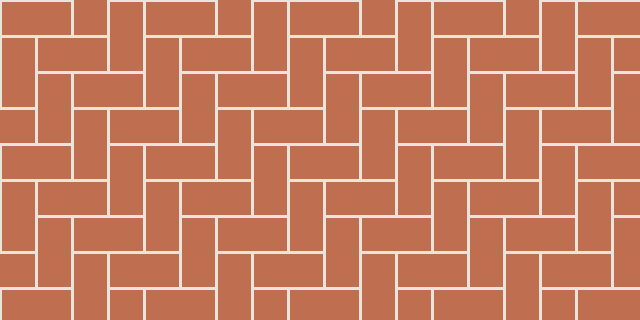
Herringbone — pgg
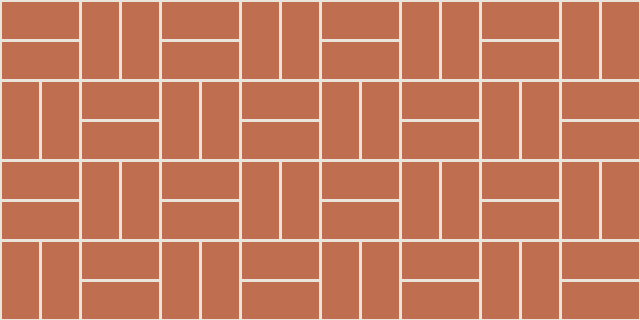
Basket weave — p4g
And the rest
- Square tiles, plain — p4m. Offset them by half (running bond of squares) and it drops to cmm.
- Hexagonal pavers — p6m.
- Diagonal herringbone (45°) — still pgg; rotating the whole pattern changes nothing.
- Pinwheel parquet (four bricks around a small square) — p4 if the pinwheels all spin the same way, p4g if they alternate.
- Chevron (herringbone with the brick ends cut square so the rows are straight) — cm: the cut ends create true vertical mirrors where the zigzags meet.
Every one of these is a collectible group in the app, and because bricks are everywhere, a single street usually offers three or four of them.
More guides
- How to identify a wallpaper group by eye
- Glide reflection, explained
- Why nothing that repeats can have five-fold symmetry
- Colors vs structure: when two colors change the symmetry group
- The Alhambra question: are all 17 wallpaper groups really there?
See it on your own photos.
Symmetry Hunter identifies the
group from a picture, draws every mirror, glide, and rotation center on it, and keeps score as you
collect all 17 in the wild.