Wallpaper group p6m
The honeycomb and the triangular tiling — the full hexagonal symmetry.
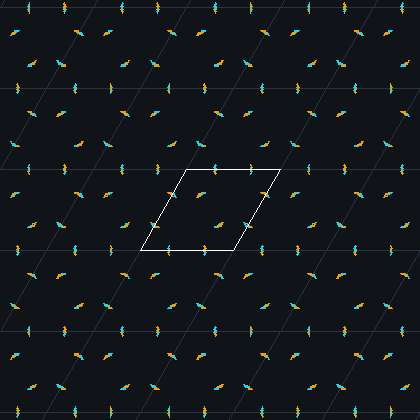
Diagram: teal glyphs are rotations and translations of the original, amber glyphs are its mirror images; the outlined parallelogram is one unit cell. Generated from the same group definition the app classifies with.
p6m is the biggest wallpaper group: 6-fold, 3-fold and 2-fold centers,
mirrors in six directions, and every center on a mirror — *632. It is the symmetry of the regular
hexagonal tiling, of the plain triangular tiling, and of the marble floor of squares, triangles and hexagons
in the app's own demo photo.
Because the hexagon is such a natural tile and six-fold stars are so decorative, p6m is the second most common group in the built world after p4m: honeycomb tile, hex paving, the great Islamic six- and twelve- pointed star patterns, snowflake prints.
How to recognize it
- A 60° turn works, and mirrors run through the 6-fold centers in six directions.
- Every rotation center is on a mirror; folding the pattern along any mirror lines it up.
- Hexagons, six-pointed stars, triangles with no distinguished color.
Where you see it
Hexagonal tile and paving; honeycomb; the triangular tiling; six- and twelve-pointed Islamic star patterns; the 3.4.6.4 marble floor; snowflake prints.
Easily confused with
- p6 — if the hexagonal motifs spin (no mirrors), it is p6.
- p3m1 — if the triangles alternate in two colors that count, the 60° turn fails — p3m1.
- p31m — a three-fold star pattern with mirrors but no 60° turn is p31m or p3m1.
The general method: find the highest-order rotation center, then ask about mirrors, then glides — see how to identify a wallpaper group.
In the wild
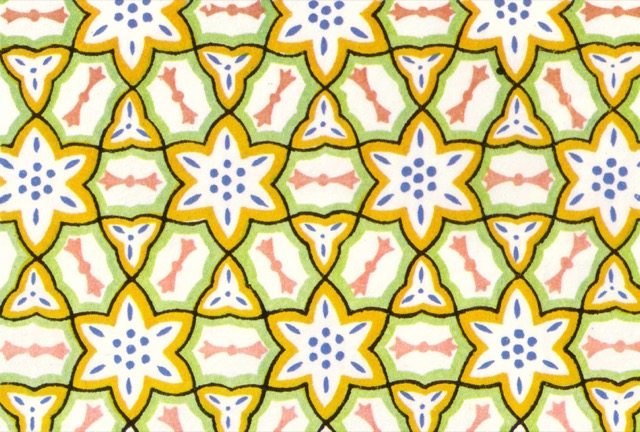
Public-domain plates (Owen Jones, The Grammar of Ornament, 1856, via Wikimedia Commons), each classified by the app's engine to confirm the label.

See it on your own photos.
Symmetry Hunter identifies the
group from a picture, draws every mirror, glide, and rotation center on it, and keeps score as you
collect all 17 in the wild.