Wallpaper group pgg
Glides both ways and half-turns, not a single true mirror.
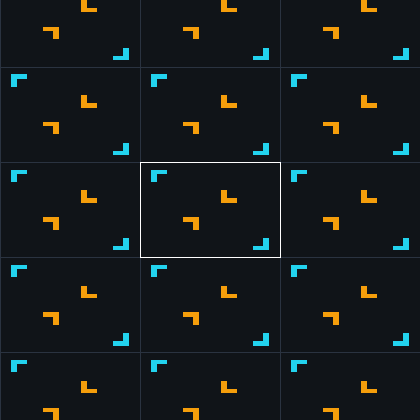
Diagram: teal glyphs are rotations and translations of the original, amber glyphs are its mirror images; the outlined parallelogram is one unit cell. Generated from the same group definition the app classifies with.
pgg has glide reflections in two perpendicular directions and 2-fold
centers, but no mirror lines at all. Every copy of the motif is either the original, its half-turn, or a
flipped-and-shifted version — never a straight reflection. The orbifold name 22× is two
free half-turn centers and a glide.
The everyday example is herringbone: parquet floors and herringbone brick. Each brick's neighbor across the zigzag is its mirror image shifted along, and the pattern can be turned 180° about the point where two bricks meet end-to-side — but there is no line you can fold it on.
How to recognize it
- Try every candidate mirror line: none works. Then try reflect-and-slide along two perpendicular directions: both work.
- A 180° turn about the right points lines the pattern up.
- Herringbone, zigzag brickwork and 'spinning' two-way layouts are the signature.
Where you see it
Herringbone parquet and paving; herringbone and chevron brick bonds; some woven and knitted structures; Escher's pgg lizards.
Easily confused with
- pmg — if one of the two directions is actually a true mirror, it is pmg.
- p2 — if there are no glides either — just half-turns — it is p2.
- p4g — a 90° herringbone laid as basket weave gains 4-fold centers and mirrors — that is p4g.
The general method: find the highest-order rotation center, then ask about mirrors, then glides — see how to identify a wallpaper group.
See it on your own photos.
Symmetry Hunter identifies the
group from a picture, draws every mirror, glide, and rotation center on it, and keeps score as you
collect all 17 in the wild.