Colors vs structure: when two colors change the symmetry group
How coloring changes a pattern's wallpaper group — the checkerboard, the two-colored triangular tiling, diapered brickwork — and why the honest answer is to say which reading you chose.
Take a plain square grid: p4m. Now color the squares alternately black and white. Nothing moved, but has the symmetry changed? It depends on a decision you have to make consciously: do the two colors count as different?
The checkerboard
If colors count, the pattern's symmetries are the movements that send black squares to black squares. The 90° turn about the center of a black square still works; so does the mirror through that square's center, and the diagonal mirror. What fails is the translation by one square — it swaps colors — so the unit cell doubles. The group is still p4m, just with a bigger cell. The checkerboard is the gentle case.
The two-colored triangular tiling
The plain triangular tiling is p6m: six-fold centers at every vertex, mirrors in six directions. Color the triangles alternately — every up-triangle one color, every down-triangle another — and the 60° turn about a vertex now swaps colors. It is gone. The 120° turn about a triangle's center keeps colors, and three mirror directions survive. The group has dropped to p3m1. Ignore the colors and it is p6m again. One pattern, two correct answers, depending on what "the same" means.
Why this is not a flaw
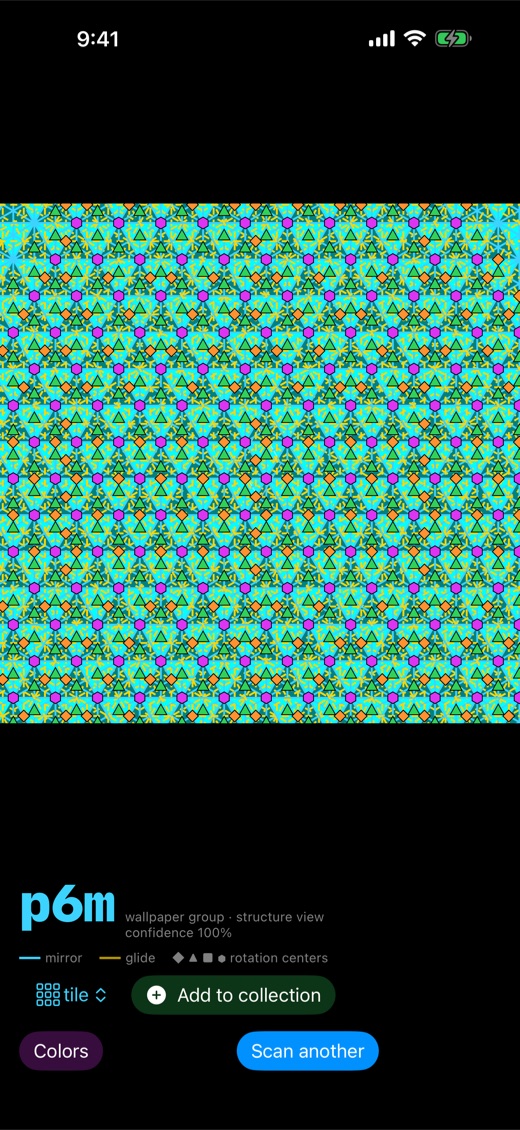
Mathematicians handle it with color symmetry: a movement that permutes the colors consistently is a "color symmetry" even if it is not a plain symmetry. The two-colored triangular tiling has p6m as its color-symmetry group and p3m1 as its ordinary group, and both statements are true. For a classifier, the only wrong move is to be inconsistent. Symmetry Hunter therefore classifies colors as different by default — the reading closest to what the designer drew — and offers the Structure view for the colors-blind reading, with the difference shown on the overlay.
Where it matters in the wild
- Diapered brickwork — dark headers forming diamonds in a Tudor wall. Uniform bricks give cmm; the diamond pattern of dark headers, read with colors, usually gives a larger cell and sometimes a different group.
- Islamic star patterns — the underlying line structure is often p6m or p4m; the coloring of the regions frequently lowers it.
- Quilts — nearly every quilt block has two readings, and quilters often design for exactly that effect.
- Grouting — the lines between tiles are part of the structure; a dark grout on light tile does not change the group, but a pattern in the grout does.
More guides
- How to identify a wallpaper group by eye
- Glide reflection, explained
- Why nothing that repeats can have five-fold symmetry
- What symmetry group is a brick wall? Bonds and parquet, classified
- The Alhambra question: are all 17 wallpaper groups really there?
See it on your own photos.
Symmetry Hunter identifies the
group from a picture, draws every mirror, glide, and rotation center on it, and keeps score as you
collect all 17 in the wild.