THE 17 WALLPAPER GROUPS, EXPLAINED
Every flat pattern that repeats in two directions — a tiled floor, a brick wall, a printed fabric, an Islamic mosaic — has exactly one of 17 possible symmetry structures. Here is the theorem behind that number, what the 17 groups are, how to tell them apart by eye, and where each one hides in the real world.
Jump to: the four symmetries · the theorem · the 17 groups · how to identify them · in the wild · friezes · rosettes · the orbifold shortcut
// the four symmetries
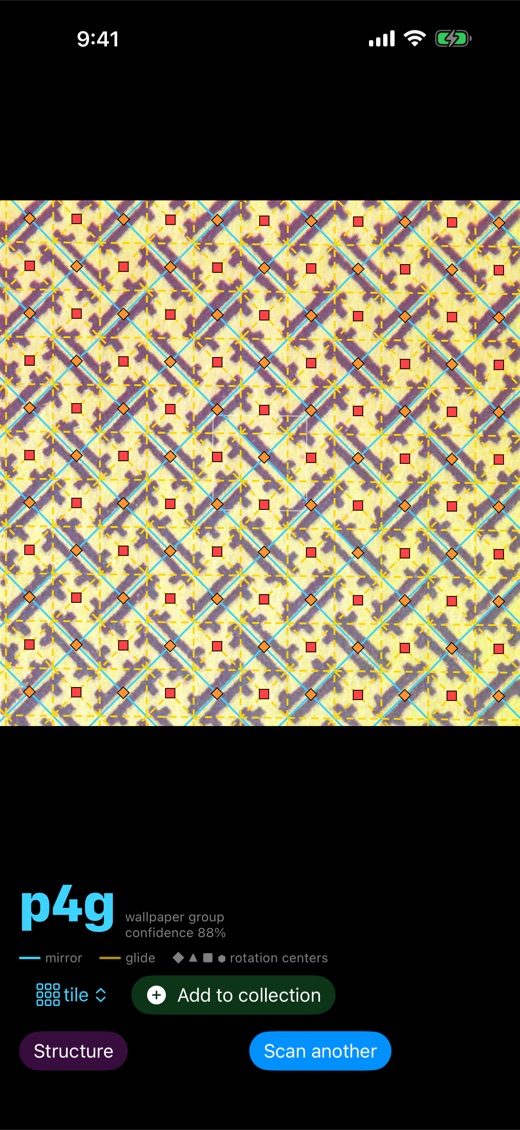
A symmetry of a pattern is a movement of the plane — an isometry — that leaves the pattern looking exactly as it did. For a repeating flat pattern there are only four kinds:
- Translation — slide the pattern along and it lines up with itself. Every wallpaper pattern has translations in two independent directions; that is what "repeating" means. The two shortest ones span the pattern's lattice, and the parallelogram they form is its unit cell.
- Rotation — turn the pattern about a point and it lines up. A point you can turn about by 180° is a 2-fold center; 120° is 3-fold; 90° is 4-fold; 60° is 6-fold.
- Reflection — flip the pattern across a line (a mirror) and it lines up.
- Glide reflection — flip across a line and slide along it by half a repeat. Footprints in snow are the classic example: the left print reflected and shifted gives the right print, but no plain mirror maps one onto the other.
A pattern's symmetry group is the complete set of movements that leave it unchanged. Two patterns that look nothing alike — a brick wall and a woven basket — can have the same group, because what is being compared is the structure of the movements, not the picture.
// the theorem
Theorem (Fedorov 1891; rediscovered independently by Pólya and Niggli in 1924). Let G be a group of isometries of the Euclidean plane that is discrete and contains translations in two independent directions. Then G is one of exactly 17 groups, up to a change of coordinates.
"Discrete" rules out patterns with arbitrarily small repeats; "two independent directions" is what makes it wallpaper rather than a strip. In three dimensions the same question — the symmetry groups of crystals — has 230 answers, the space groups, which is what Fedorov was actually after.
The proof is a classification in four steps, and each step is something you can see in a pattern:
- The translations form a lattice. Take the two shortest independent translations; every translation in the group is a whole-number combination of them. Up to shape there are only five kinds of plane lattice — oblique, rectangular, centered rectangular (rhombic), square, and hexagonal — the five two-dimensional Bravais lattices.
- The crystallographic restriction. Any rotation in the group must map the lattice onto itself. Write the rotation by angle θ in lattice coordinates: it becomes a matrix of whole numbers, so its trace, 2 cos θ, must be a whole number. That leaves cos θ ∈ {−1, −½, 0, ½, 1}, i.e. θ ∈ {180°, 120°, 90°, 60°, 360°}: only 2-, 3-, 4-, and 6-fold rotations can exist. Five-fold and eight-fold symmetry are impossible for anything that repeats — the crystallographic restriction theorem.
- The point group. Forget the translations and look only at which rotations and reflections occur. The result is a finite group of the allowed kinds: cyclic C1,2,3,4,6 (rotations only) or dihedral D1,2,3,4,6 (rotations plus mirrors) — ten possibilities, each compatible with only some of the five lattices.
- Mirrors or glides? Finally, for each reflection ask whether it can be realized as a true mirror or is forced to be a glide. This is the step that splits pm from pg, pmm from pmg and pgg, p4m from p4g — and, on the hexagonal lattice, the two ways of orienting three mirrors give p3m1 and p31m. Thirteen groups have every reflection as a true mirror; four (pg, pmg, pgg, p4g) need at least one glide with no mirror parallel to it. Thirteen plus four is seventeen.
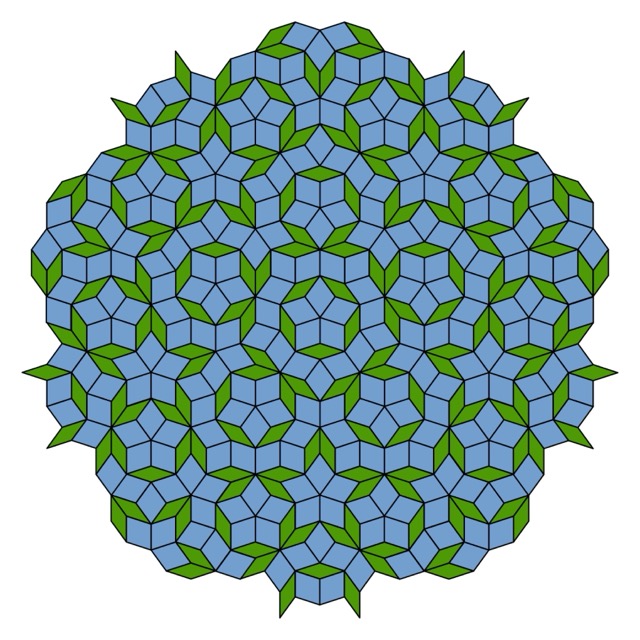
This is also why a Penrose tiling is refused as a wallpaper pattern: its five-fold order is real, but by step 2 it can never repeat, so it belongs to no wallpaper group at all. The Alhambra in Granada is the traditional place to go hunting for all 17; whether every one of them is really there has been argued in the literature for fifty years.
// the 17 groups
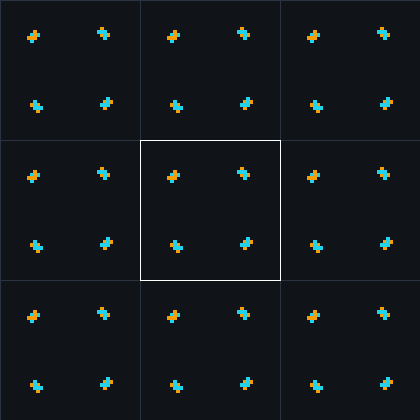
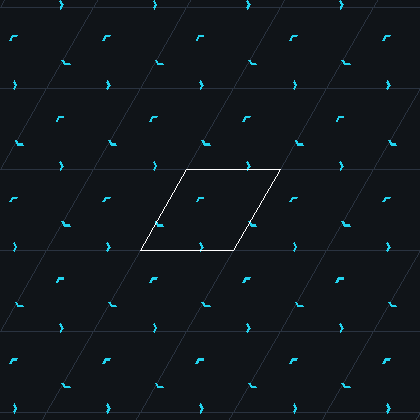
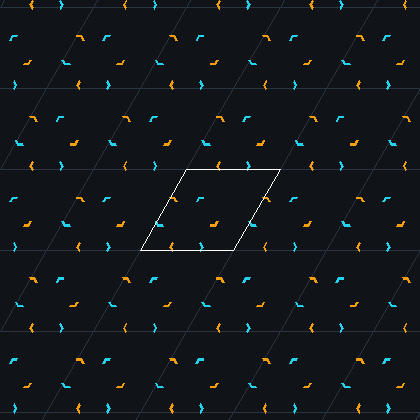
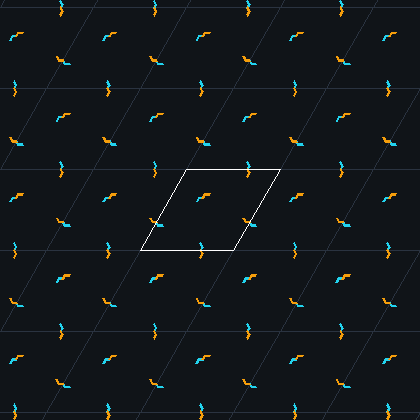
Each diagram takes one asymmetric glyph and repeats it by every symmetry of the group: cyan copies are rotations and translations of the original, amber copies are its mirror images — so amber appearing at all means the group has reflections or glides. The white outline is one unit cell. Symbols are the standard crystallographic (Hermann–Mauguin) names that Symmetry Hunter uses; the small symbol beneath is Conway's orbifold notation, explained below. Each name links to Wikipedia's entry for that group. Rarity is how often the group turns up in the built world, measured from field data — it is what the app's collection scores.
| Group | Lattice | Rotations | Mirrors | Glides | Where you see it | Rarity | |
|---|---|---|---|---|---|---|---|
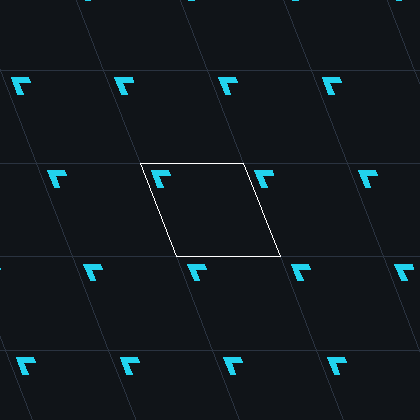 |
p1 o |
oblique | none | none | none | A single asymmetric motif simply repeated — many printed fabrics and wrapping papers. | Uncommon |
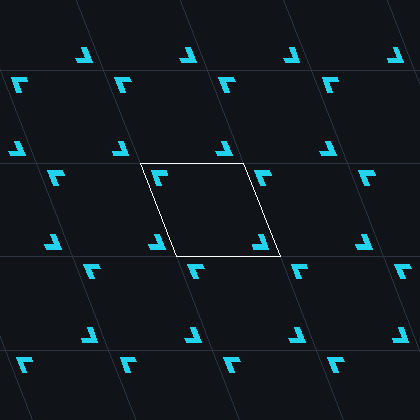 |
p2 2222 |
oblique | 2-fold | none | none | Asymmetric motifs paired head-to-tail; S- and Z-shaped repeats; some parquet. | Uncommon |
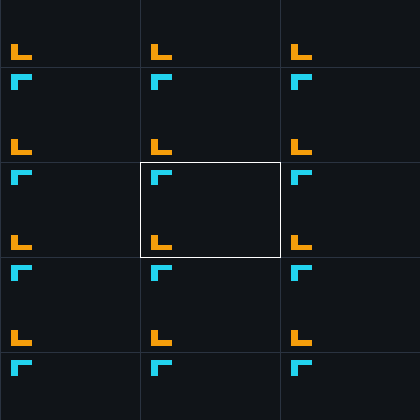 |
pm ** |
rectangular | none | one direction | none | Stripes of mirror-symmetric motifs; vertical bands of leaves or arches. | Uncommon |
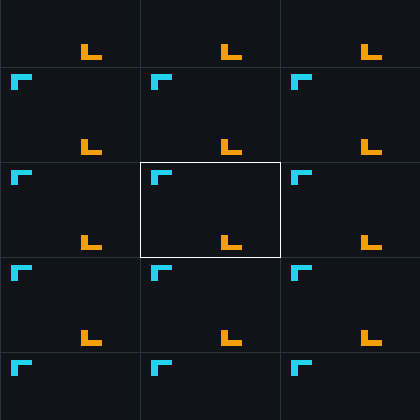 |
pg ×× |
rectangular | none | none | one direction | The glide-only group: alternating rows of a motif and its reflection, shifted by half a repeat — rare in the wild, the collector's trophy. | Legendary |
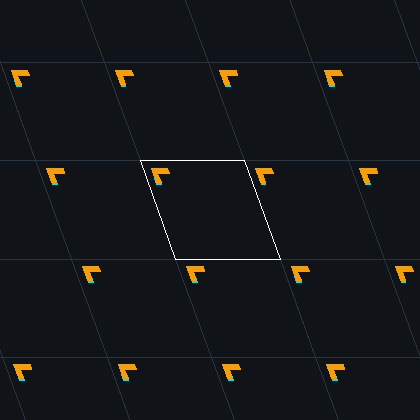 |
cm *× |
rhombic | none | one direction | between the mirrors | Fish-scale and scallop patterns; chevrons and zigzags with a vertical mirror. | Uncommon |
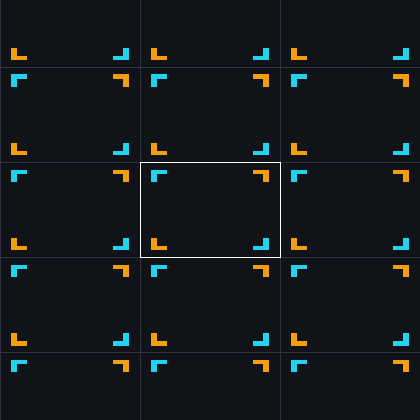 |
pmm *2222 |
rectangular | 2-fold | two directions | none | Rectangular grids: window panes, stacked-bond brick, plain rectangular tiles. | Common |
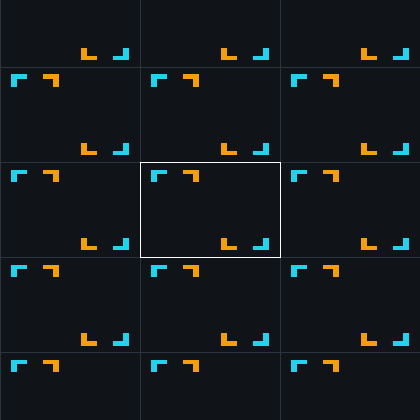 |
pmg 22* |
rectangular | 2-fold | one direction | perpendicular to the mirrors | Rows of symmetric arches alternating up and down; some ironwork and lattice fences. | Rare |
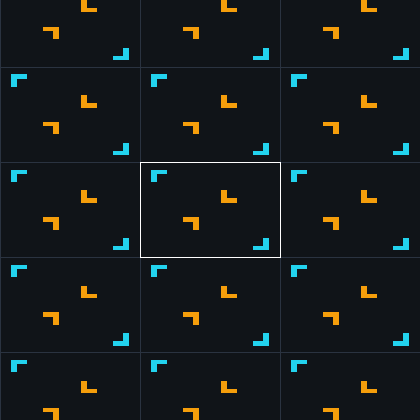 |
pgg 22× |
rectangular | 2-fold | none | two directions | Herringbone parquet and herringbone brick — glides both ways, not a single mirror. | Epic |
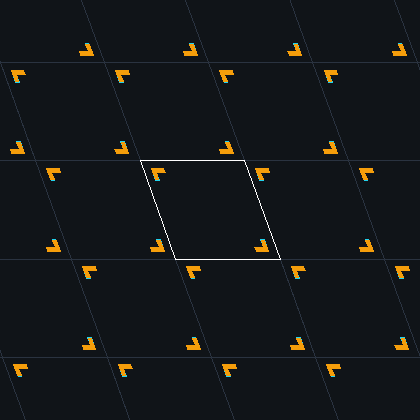 |
cmm 2*22 |
rhombic | 2-fold | two directions | yes | Running-bond brick walls, offset checkerboards, diamond lattices, most knit and weave diagrams. | Common |
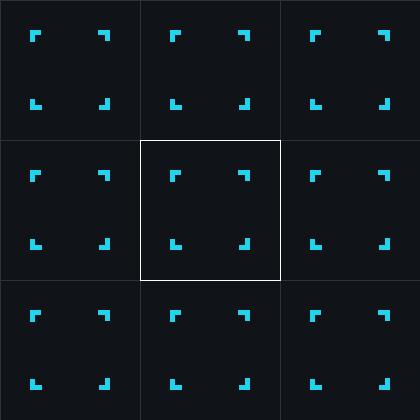 |
p4 442 |
square | 4-fold, 2-fold | none | none | Pinwheel tilings and swirling square motifs with no mirror line anywhere. | Uncommon |
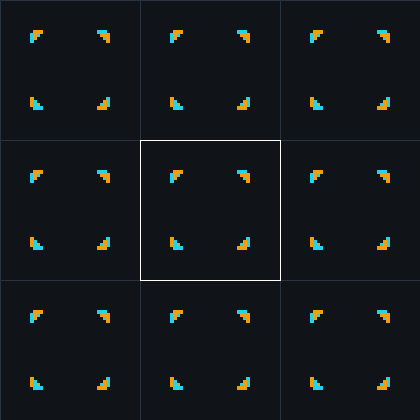 |
p4m *442 |
square | 4-fold, 2-fold | four directions | yes | The checkerboard, the square grid, most bathroom and kitchen tile — the most common pattern on Earth. | Common |
 |
p4g 4*2 |
square | 4-fold, 2-fold | two directions | diagonal | Basket weave; squares rotated 90° in alternation; the 4-fold centers sit between the mirrors, not on them. | Rare |
 |
p3 333 |
hexagonal | 3-fold | none | none | Escher's interlocking lizards; three-armed motifs with no reflection. | Rare |
 |
p3m1 *333 |
hexagonal | 3-fold | three directions | yes | The two-colored triangular tiling (when the colors count); every 3-fold center lies on a mirror. | Epic |
 |
p31m 3*3 |
hexagonal | 3-fold | three directions | yes | Trefoil and knot patterns in Islamic and Celtic work; some 3-fold centers lie off the mirrors — the tell that separates it from p3m1. | Epic |
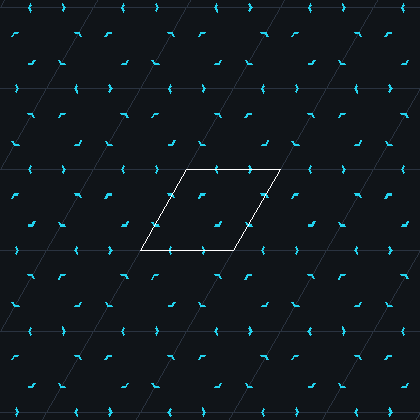 |
p6 632 |
hexagonal | 6-fold, 3-fold, 2-fold | none | none | Six-armed whirls and chiral florets — hexagonal, spinning, mirror-free. | Rare |
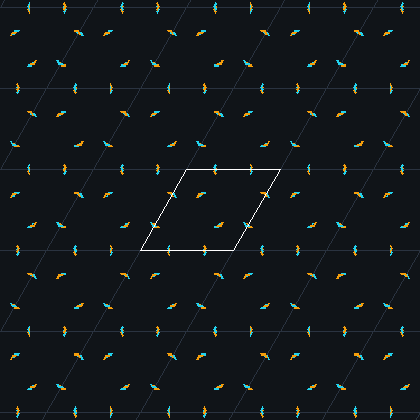 |
p6m *632 |
hexagonal | 6-fold, 3-fold, 2-fold | six directions | yes | Honeycomb hex tile, the plain triangular tiling, the marble floor of squares, triangles, and hexagons — the second most common pattern anywhere. | Common |
// how to tell them apart
Identifying a wallpaper group by eye is a short decision tree. Find the highest-order rotation center first, then ask about mirrors, then about glides.
- No rotation at all
- Mirrors present → are there glide lines between the mirrors?
yes →
cm· no →pm - No mirrors → glides present? yes →
pg· no →p1
- Mirrors present → are there glide lines between the mirrors?
yes →
- Highest rotation is 2-fold (180°)
- Mirrors in two directions → are all 2-fold centers on mirrors?
yes →
pmm· no →cmm - Mirrors in one direction only →
pmg - No mirrors → glides present? yes →
pgg· no →p2
- Mirrors in two directions → are all 2-fold centers on mirrors?
yes →
- Highest rotation is 3-fold (120°)
- Mirrors → are all 3-fold centers on mirrors?
yes →
p3m1· no →p31m - No mirrors →
p3
- Mirrors → are all 3-fold centers on mirrors?
yes →
- Highest rotation is 4-fold (90°)
- Mirrors → do mirrors pass through the 4-fold centers?
yes →
p4m· no →p4g - No mirrors →
p4
- Mirrors → do mirrors pass through the 4-fold centers?
yes →
- Highest rotation is 6-fold (60°)
- Mirrors →
p6m· no mirrors →p6
- Mirrors →
Colors change the answer
A checkerboard is p4m. But if you decide the two colors are "the same" and
look only at the grid of lines, the pattern becomes a plain square grid — also
p4m, with a smaller unit cell. Do the same with a two-colored triangular
tiling and it jumps from p3m1 to p6m: the coloring was breaking
the 6-fold centers. Whether colors count is a choice, and the honest thing is to say
which choice you made. Symmetry Hunter classifies colors-as-distinct by default and has a
Structure toggle for the other reading.
// in the wild
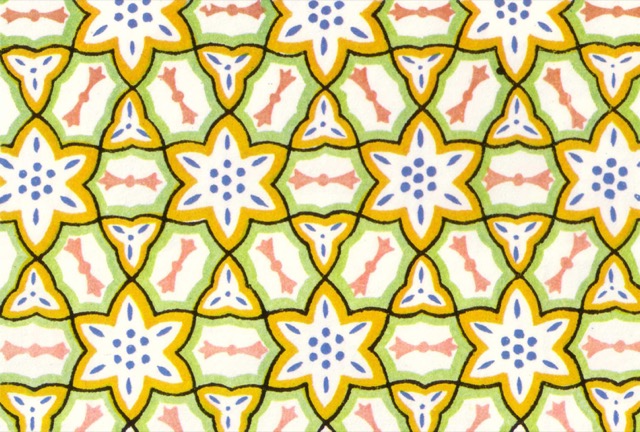
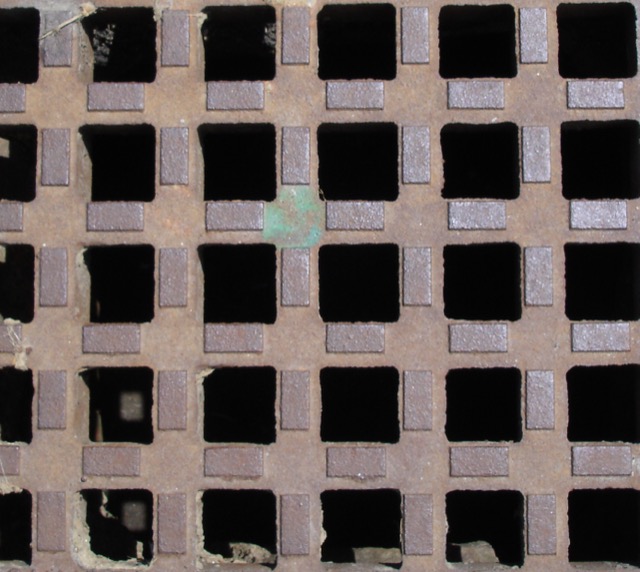
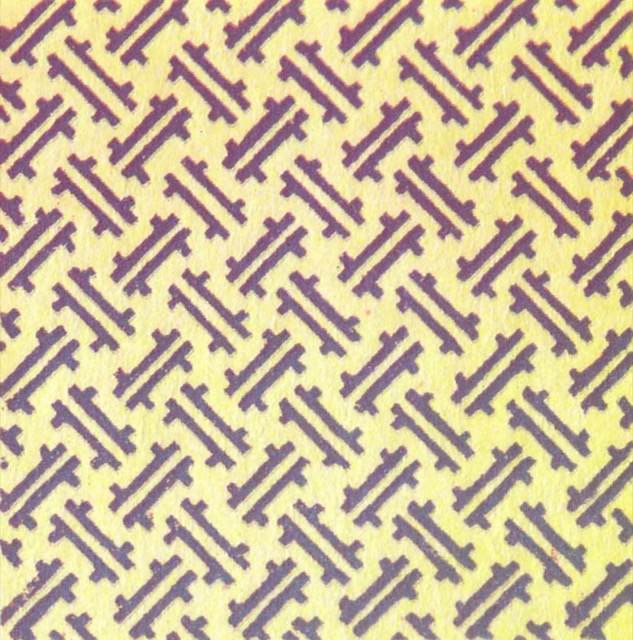
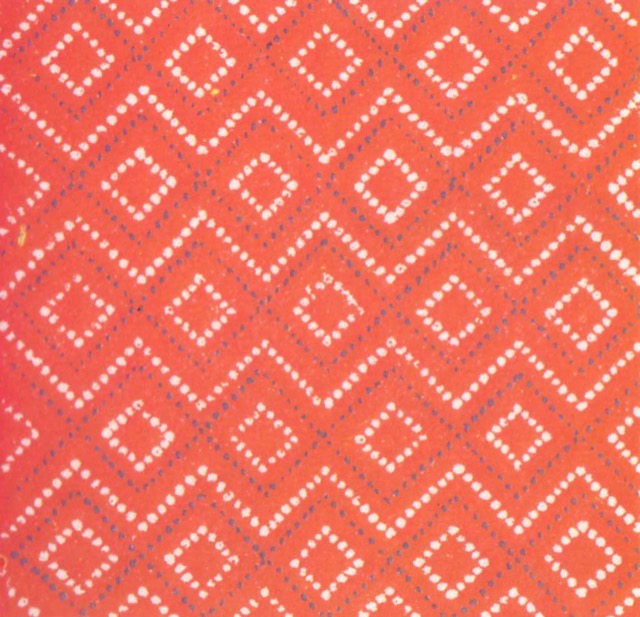
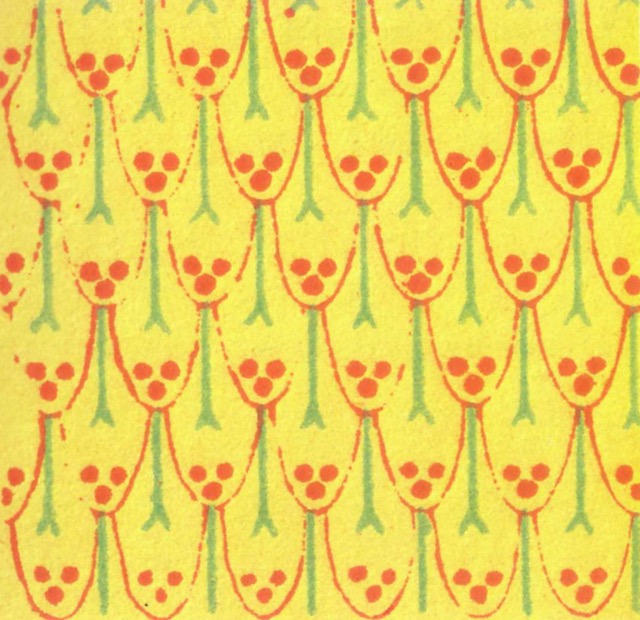
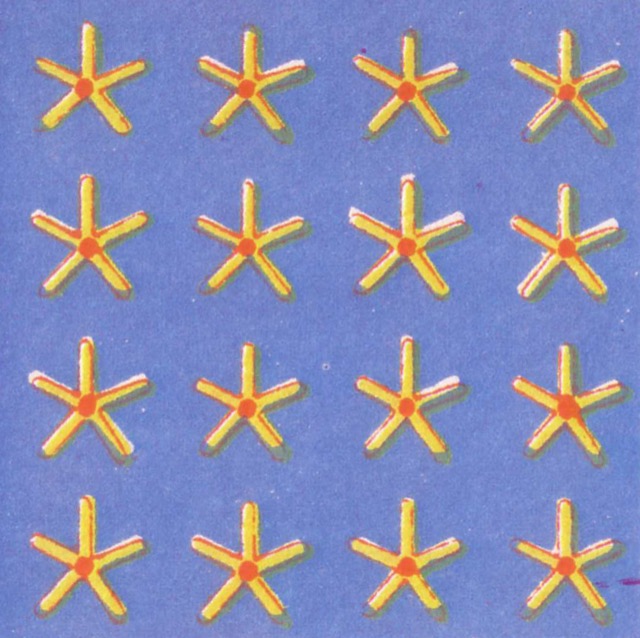
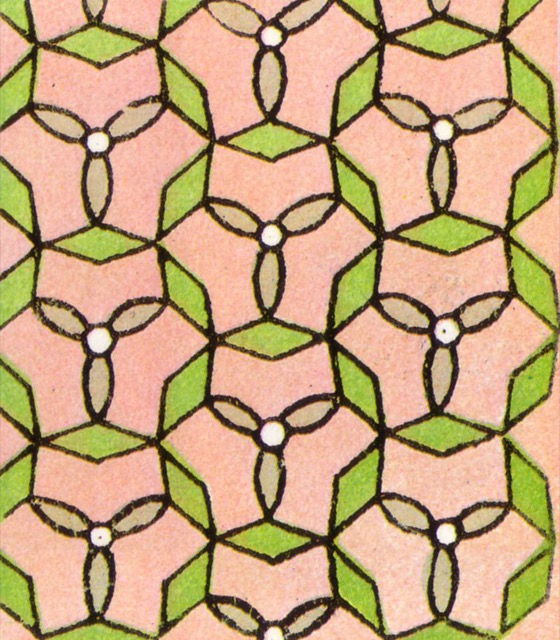
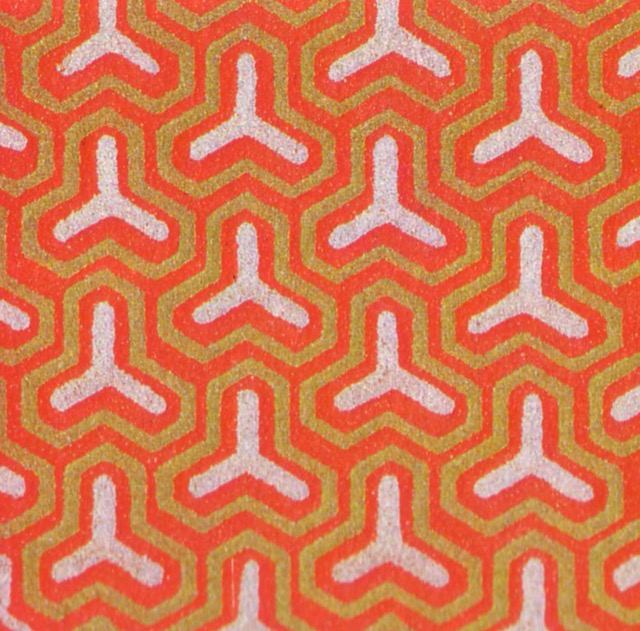
Real patterns, not diagrams. These plates are public domain — most are from Owen Jones's The Grammar of Ornament (1856), via Wikimedia Commons — and every one was classified by the app's own engine to confirm the label.
// the 7 frieze groups
Patterns that repeat along a single strip — borders, railings, cornices, a line of footprints — have only one translation direction, and the same reasoning yields exactly seven frieze groups. John Conway gave them names you can act out.
| Group | Conway name | Symmetries | Where you see it | Rarity | |
|---|---|---|---|---|---|
 |
p1 ∞∞ | hop | translation only | A motif repeated along a border with no other symmetry. | Uncommon |
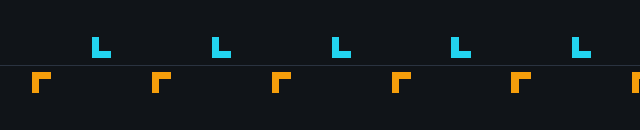 |
p11g ∞× | step | glide reflection | Footprints in snow; alternating leaves on a stem. The frieze trophy. | Epic |
 |
p1m1 *∞∞ | sidle | vertical mirrors | Rows of symmetric arches, balusters, or shields. | Uncommon |
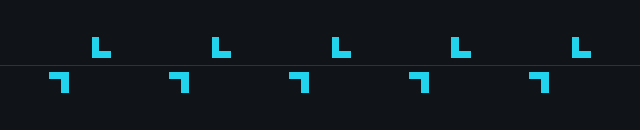 |
p2 22∞ | spinning hop | 2-fold rotations | S-scroll borders; a motif and its 180° turn alternating. | Uncommon |
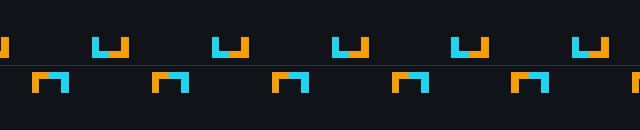 |
p2mg 2*∞ | spinning sidle | vertical mirrors + glide + 2-fold | Alternating up/down symmetric motifs — many Greek key and wave borders. | Rare |
 |
p11m ∞* | jump | horizontal mirror | A border symmetric about its centerline, like a reflected wave. | Uncommon |
 |
p2mm *22∞ | spinning jump | both mirrors + 2-fold | Rectangular railings, dentil cornices, beaded borders — the commonest frieze. | Common |
// rosettes
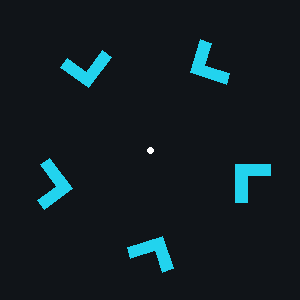

A finite design with a center — a medallion, a mandala, a hubcap, a snowflake — does not
repeat at all, so the crystallographic restriction does not apply and any rotation
order is allowed. There are just two families, the
point groups of the plane: the
cyclic groups cn (n-fold rotation, no mirrors — a
pinwheel) and the dihedral groups dn (n-fold rotation
plus n mirrors — a snowflake is d6, a regular pentagon d5). This is
where a Penrose tiling lands: refused as wallpaper, it reports its five-fold sun as a
d5 rosette.
// the orbifold shortcut
There is a second, more modern way to see why the answer is 17, due to
John Conway. Fold a pattern up by all of its symmetries
— glue every point to every point it is symmetric with — and you get a small surface with
some special points, an orbifold. Conway's notation just lists the
features: a digit for each kind of rotation center (a gyration), *
where a mirror line appears (with the rotation centers on mirrors written after
the star), × for a glide with no mirror parallel to it (a miracle), and
o for a plain wrap-around with nothing else.
Conway's "magic theorem"
Every feature has a price: a gyration of order n costs (n−1)/n; a mirror
* costs 1, and a rotation center of order n sitting on a mirror
costs (n−1)/2n; a miracle × costs 1; a wonder o costs 2. A
pattern repeats in two directions exactly when the total comes to 2.
Check it: p6 = 632 → 5⁄6 + 2⁄3 + 1⁄2 = 2. p4m =
*442 → 1 + 3⁄8 + 3⁄8 + 1⁄4 = 2. pg = ×× → 1 + 1 = 2. List every way
to spend exactly 2 euros in this shop and you get seventeen receipts — the 17 wallpaper
groups. (Spend less than 2 and you get the frieze and rosette groups; the seven friezes are
the ways to reach 2 with the infinite gyration ∞ allowed.)
// further reading
- Wallpaper group on Wikipedia — the reference article, with a diagram and example images for each of the 17.
- Conway, Burgiel & Goodman-Strauss, The Symmetries of Things (2008) — the definitive modern treatment and the source of the orbifold notation and the magic theorem.
- Grünbaum & Shephard, Tilings and Patterns (1987) — the encyclopedic reference.
- Owen Jones, The Grammar of Ornament (1856) — public-domain plates covering essentially all 17 groups; several are Symmetry Hunter's practice patterns.
- The Alhambra question: Grünbaum, "What symmetry groups are present in the Alhambra?", Notices of the AMS 53 (2006).
Put it to the test.
Symmetry Hunter identifies
the group from a photo, draws every mirror, glide, and rotation center on it, and keeps
score as you collect all 17 in the wild.