Wallpaper group p4
Quarter-turns with no mirrors: pinwheels on a square lattice.
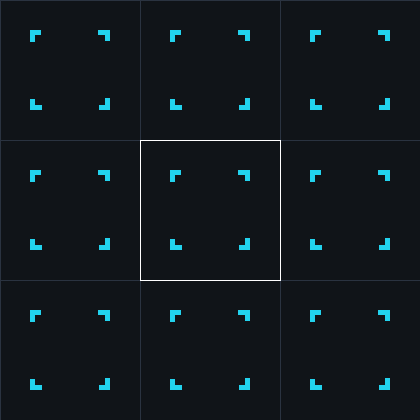
Diagram: teal glyphs are rotations and translations of the original, amber glyphs are its mirror images; the outlined parallelogram is one unit cell. Generated from the same group definition the app classifies with.
p4 has 4-fold rotation centers — points about which the pattern can be
turned 90° — and no reflections of any kind. There are two inequivalent kinds of 4-fold center and one kind
of 2-fold center, giving 442. The lattice is forced to be square.
Every copy of the motif is a rotation of the original by 0°, 90°, 180° or 270°, never a mirror image. That makes p4 patterns chiral: they spin, like pinwheels or swastika-type key patterns, and the pattern's mirror image is a different pattern spinning the other way.
How to recognize it
- A 90° turn about some point lines the pattern up.
- No mirror line works anywhere; the motifs all spin the same way.
- Two different kinds of 'hub' alternate like the black and white squares of a checkerboard.
Where you see it
Pinwheel quilts; rotating-square tilings; Greek-key and meander patterns extended to the plane; some Islamic and Chinese lattice work; p4 is Escher's favourite for four-way interlocking figures.
Easily confused with
- p4m — if mirrors pass through the 4-fold centers, it is p4m — the pattern no longer spins.
- p4g — if mirrors exist but miss the 4-fold centers, it is p4g.
- p2 — if only 180° turns work, the lattice is probably not square — p2.
The general method: find the highest-order rotation center, then ask about mirrors, then glides — see how to identify a wallpaper group.
See it on your own photos.
Symmetry Hunter identifies the
group from a picture, draws every mirror, glide, and rotation center on it, and keeps score as you
collect all 17 in the wild.