Wallpaper group p4g
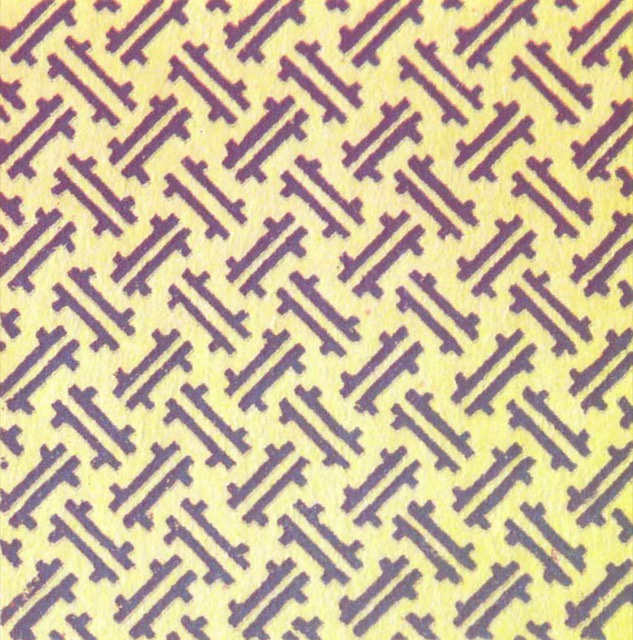
Basket weave: 4-fold centers that no mirror passes through.
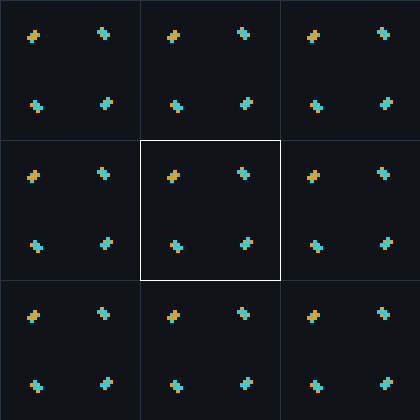
Diagram: teal glyphs are rotations and translations of the original, amber glyphs are its mirror images; the outlined parallelogram is one unit cell. Generated from the same group definition the app classifies with.
p4g has 4-fold centers and mirrors, but the mirrors run in only two
perpendicular directions and they miss the 4-fold centers. The 2-fold centers sit where the mirrors
cross; glide lines run diagonally through the 4-fold centers. The orbifold 4*2 says: a free
4-fold center, then a mirror with a 2-fold corner on it.
The classic example is basket weave: pairs of bricks laid alternately horizontal and vertical in a square grid. The 90° turn about the center of each pair works; the mirrors run along the grid lines between pairs; but a mirror through a pair's center would have to swap horizontal for vertical, and no reflection can.
How to recognize it
- 90° turns work about the centers of the motifs, but folding through those centers does not.
- Mirror lines run along the grid between motifs, in two directions only (no diagonals).
- Basket weave, pinwheel-with-a-border, and 'windmill' tilings are the signature.
Where you see it
Basket-weave brick and parquet; windmill tilings; many square-lattice Islamic patterns where rosettes are set between mirror lines; the floor in the app's own screenshots.
Easily confused with
- p4m — if a mirror does pass through the 4-fold centers, it is p4m.
- pgg — if the 90° turn fails (the pairs are not square), herringbone-type layouts drop to pgg.
- p4 — if there are no mirrors at all, it is p4.
The general method: find the highest-order rotation center, then ask about mirrors, then glides — see how to identify a wallpaper group.
In the wild
Public-domain plates (Owen Jones, The Grammar of Ornament, 1856, via Wikimedia Commons), each classified by the app's engine to confirm the label.

See it on your own photos.
Symmetry Hunter identifies the
group from a picture, draws every mirror, glide, and rotation center on it, and keeps score as you
collect all 17 in the wild.