Wallpaper group p4m
The square grid and the checkerboard — the most common pattern on Earth.
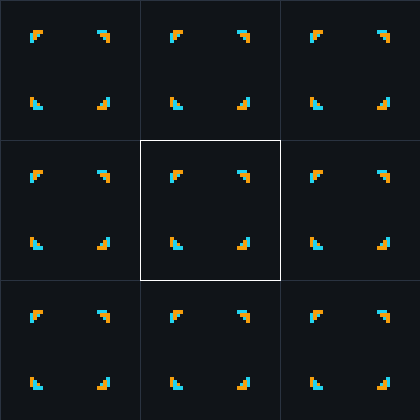
Diagram: teal glyphs are rotations and translations of the original, amber glyphs are its mirror images; the outlined parallelogram is one unit cell. Generated from the same group definition the app classifies with.
p4m is the full symmetry of the square grid: 4-fold centers, mirrors
in four directions (horizontal, vertical, and both diagonals), and every rotation center lying on a mirror —
*442, a mirror with corners of order 4, 4 and 2 on it. Glide lines run diagonally between the
mirrors.
It is the group of the checkerboard, the square tile floor, graph paper, most kitchen and bathroom tiling, and the windows of any modernist façade: so common that the app scores it lowest. Note that a two-colored checkerboard is still p4m with the colors counted — the 90° turn about a square's center keeps every color in place — but with a unit cell twice the size of the plain grid's.
How to recognize it
- 90° turns work; so do mirrors through the 4-fold centers both axis-aligned and diagonally.
- The cell is a square, and the motif is as symmetric as a square.
- Folding along a diagonal through a tile's center lines the pattern up.
Where you see it
Square tile floors and walls; checkerboards; graph paper; window grids; most pixel art and cross-stitch grids; the square paving of nearly every city.
Easily confused with
- p4g — if the diagonal fold fails and the mirrors only run between the 4-fold centers, it is p4g (basket weave).
- pmm — if 90° turns fail because the cells are rectangles, not squares, it is pmm.
- cmm — a checkerboard viewed with one color ignored is a square grid — still p4m; but an offset (running-bond) layout of squares is cmm.
The general method: find the highest-order rotation center, then ask about mirrors, then glides — see how to identify a wallpaper group.
In the wild
Public-domain plates (Owen Jones, The Grammar of Ornament, 1856, via Wikimedia Commons), each classified by the app's engine to confirm the label.
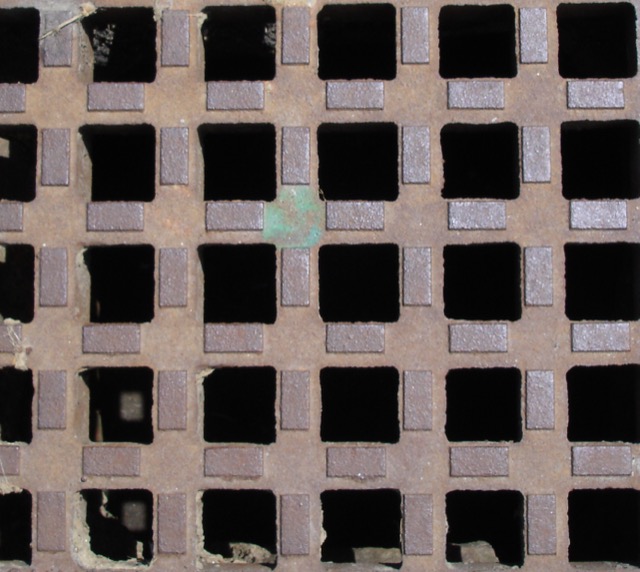

See it on your own photos.
Symmetry Hunter identifies the
group from a picture, draws every mirror, glide, and rotation center on it, and keeps score as you
collect all 17 in the wild.