Wallpaper group cmm
Mirrors both ways on a staggered lattice — the brick wall.
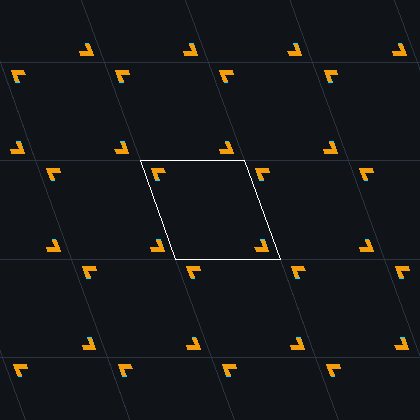
Diagram: teal glyphs are rotations and translations of the original, amber glyphs are its mirror images; the outlined parallelogram is one unit cell. Generated from the same group definition the app classifies with.
cmm has perpendicular mirrors in two directions, like pmm, but on a
rhombic lattice: the rows are offset by half a repeat. That stagger creates 2-fold centers that lie on no
mirror — at the center of each rhombus — alongside the ones at mirror crossings. The orbifold
2*22 reads: one free half-turn, then a mirror with two corners on it.
This is the group of the ordinary brick wall in running bond, of the offset checkerboard, of diamond lattices and most knit and weave diagrams. It is one of the four groups you will find almost everywhere.
How to recognize it
- Mirrors run both vertically and horizontally through the motifs.
- The rows (or columns) are staggered by half a repeat, so the lattice is a rhombus or a 'diamond'.
- Some 2-fold centers are where mirrors cross; others sit in the middle of the gaps where no mirror passes.
Where you see it
Running-bond and Flemish-bond brick; offset tile; diamond trellis; honeycomb-like rhombic lattices; chain-link fence; most argyle.
Easily confused with
- pmm — if the rows are not staggered, every center is on a mirror — pmm.
- p4m — if the staggered cell happens to be a square turned 45°, 90° turns also work — p4m.
- cm — if only one direction has mirrors, it is cm.
The general method: find the highest-order rotation center, then ask about mirrors, then glides — see how to identify a wallpaper group.
In the wild
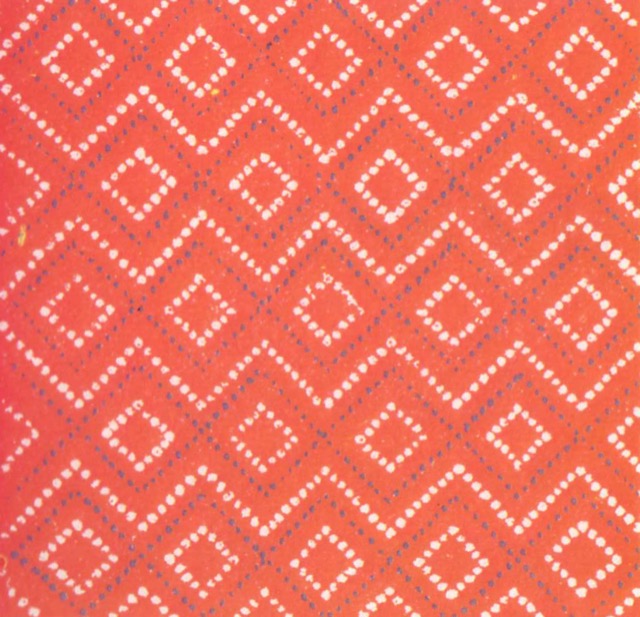
Public-domain plates (Owen Jones, The Grammar of Ornament, 1856, via Wikimedia Commons), each classified by the app's engine to confirm the label.

See it on your own photos.
Symmetry Hunter identifies the
group from a picture, draws every mirror, glide, and rotation center on it, and keeps score as you
collect all 17 in the wild.