Wallpaper group cm
Mirrors in one direction with glides slipped in between.
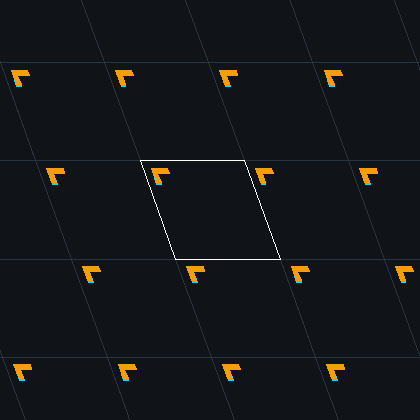
Diagram: teal glyphs are rotations and translations of the original, amber glyphs are its mirror images; the outlined parallelogram is one unit cell. Generated from the same group definition the app classifies with.
cm has mirrors in one direction, like pm, but its rows are staggered:
shift one row by half a repeat relative to the next and the lines halfway between the mirrors become glide
lines. The lattice becomes rhombic — centered rectangular — because the stagger adds a lattice point
at the center of every rectangle. The orbifold name *× says it: one mirror family, one glide.
It is the group of fish scales, scallops, and most chevron and zigzag patterns: each scale is mirror- symmetric about its own axis, and successive rows are offset by half a scale.
How to recognize it
- Vertical mirror lines through each motif, with rows (or columns) offset by half a repeat.
- No rotation: the scales or chevrons all point the same way.
- Halfway between two mirrors, reflect-and-slide maps the pattern onto itself.
Where you see it
Fish-scale and scallop tiles; chevrons, zigzags and herringbone textiles (herringbone brick is different — see pgg); roof shingles; imbricated patterns on armor and ceramics.
Easily confused with
- pm — if the rows are not staggered — motifs stacked directly above each other — it is pm.
- cmm — if there is also a horizontal mirror (so the motifs can be flipped top-to-bottom), it is cmm.
- p3m1 / p31m — a staggered arrangement on an exactly hexagonal lattice may have 3-fold centers; check for 120° turns.
The general method: find the highest-order rotation center, then ask about mirrors, then glides — see how to identify a wallpaper group.
In the wild
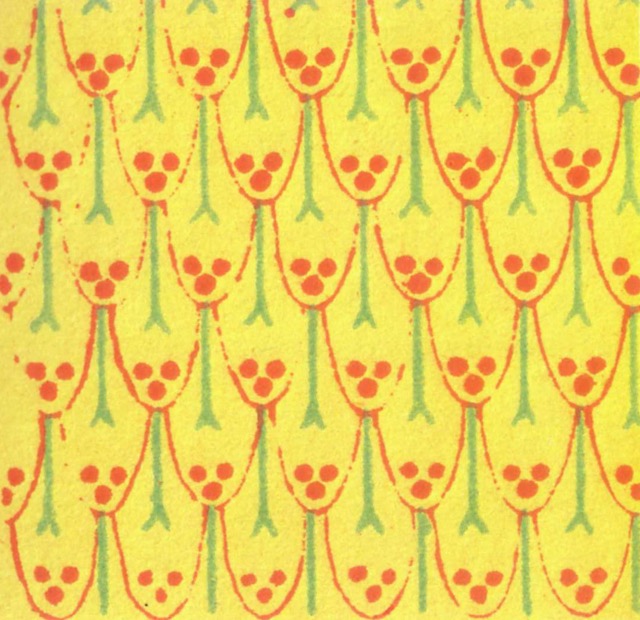
Public-domain plates (Owen Jones, The Grammar of Ornament, 1856, via Wikimedia Commons), each classified by the app's engine to confirm the label.

See it on your own photos.
Symmetry Hunter identifies the
group from a picture, draws every mirror, glide, and rotation center on it, and keeps score as you
collect all 17 in the wild.