The 7 frieze groups
Patterns that repeat along a single strip — borders, railings, cornices, a line of footprints — have only one translation direction, and the same reasoning that gives 17 wallpaper groups gives exactly seven frieze groups. John Conway gave them names you can act out.
A frieze group is a discrete group of plane isometries whose translations all run along one line. The possible extra symmetries are: mirrors across the strip (perpendicular to it), a mirror along it (the centerline), half-turns about points on the centerline, and a glide along the centerline. Combine them consistently and you get seven, no more.
The diagrams repeat one asymmetric glyph by every symmetry of the group: teal copies are translations and half-turns, amber copies are reflections or glides. The faint line is the strip's centerline.

A motif repeated along a strip with no other symmetry at all.

Footprints in snow: each motif is the previous one reflected and stepped forward.

Mirror lines across the strip, like a row of arches.

A motif and its 180° turn, alternating.
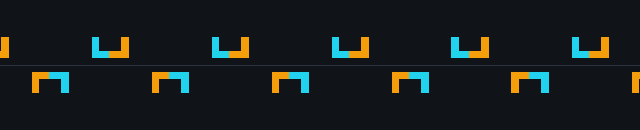
Mirror pairs that alternate up and down.

A border symmetric about its own centerline.

Full rectangular symmetry — the commonest frieze.
Why the names?
Conway's names describe how to walk so that your footprints have that symmetry: hop (one foot),
step (normal walking — the glide), sidle (sideways, feet together), jump (both feet,
leaving mirror-image prints), and the spinning variants for the ones with half-turns. In orbifold
notation the infinite translation shows up as ∞, and the magic
theorem still holds with the same prices.
See it on your own photos.
Symmetry Hunter identifies the
group from a picture, draws every mirror, glide, and rotation center on it, and keeps score as you
collect all 17 in the wild.