Wallpaper group pmg
Mirrors one way, glides the other, half-turns between the mirrors.
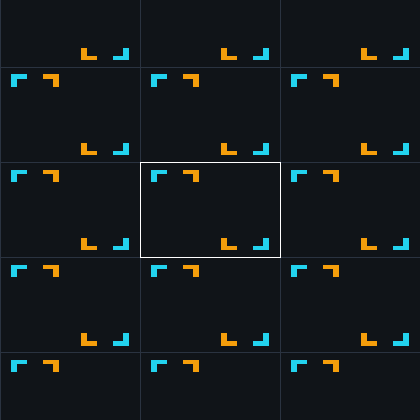
Diagram: teal glyphs are rotations and translations of the original, amber glyphs are its mirror images; the outlined parallelogram is one unit cell. Generated from the same group definition the app classifies with.
pmg has true mirrors in one direction only; perpendicular to them run
glide lines, and the 2-fold centers sit on the glide lines, halfway between the mirrors. The orbifold name
22* lists two kinds of center that are not on a mirror, then one mirror.
Picture a row of symmetric arches, then the next row with the arches upside down, each inverted arch nestled between two upright ones. The vertical mirrors through each arch survive; the horizontal line between the rows is a glide, not a mirror, because the inverted arches are shifted by half an arch.
How to recognize it
- Vertical (say) mirror lines through the motifs, but no horizontal mirror anywhere.
- Alternate rows are upside down and shifted by half a repeat.
- The half-turn centers are between the mirrors, on the line where the rows meet.
Where you see it
Rows of alternating up-and-down arches, hearts or shields on ironwork and fences; some lattice gates; certain Islamic strapwork borders extended to the plane.
Easily confused with
- pmm — if the upside-down rows are not shifted, the row boundary is a true mirror — pmm.
- pgg — if there are no true mirrors at all, only glides both ways, it is pgg.
- cmm — if both directions have mirrors but the rows are staggered, it is cmm.
The general method: find the highest-order rotation center, then ask about mirrors, then glides — see how to identify a wallpaper group.
See it on your own photos.
Symmetry Hunter identifies the
group from a picture, draws every mirror, glide, and rotation center on it, and keeps score as you
collect all 17 in the wild.