Wallpaper group p2
Half-turns only: four kinds of 2-fold center, no mirrors.
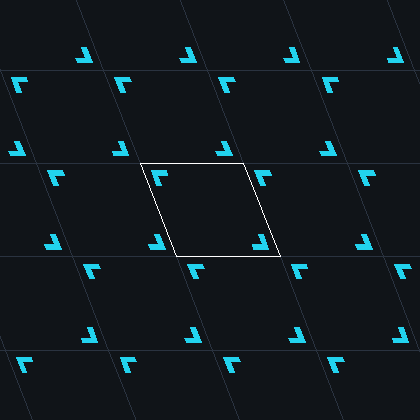
Diagram: teal glyphs are rotations and translations of the original, amber glyphs are its mirror images; the outlined parallelogram is one unit cell. Generated from the same group definition the app classifies with.
p2 adds one thing to plain repetition: points about which the pattern
can be turned 180°. There are four inequivalent kinds of them in every cell — at the corners, at the centers,
and at the midpoints of the two kinds of edge — which is where the orbifold name 2222 comes
from. There are still no mirrors and no glides, so every copy of the motif is either the original or the
original upside down, never a flipped version.
Like p1 it sits on the oblique lattice. It is the group of any motif paired head-to-tail with its own half-turned copy: S-scrolls, Z-shaped repeats, a leaf and the same leaf rotated.
How to recognize it
- Half the motifs are upside-down copies of the other half, and a 180° turn about the midpoint between a pair swaps them.
- No motif is a mirror image of another — hold the pattern up to a mirror and it looks different.
- The lattice is often visibly skewed; nothing forces right angles.
Where you see it
S- and Z-shaped repeats in textiles; some parquet and brick layouts of asymmetric pieces; Escher's two-motif tessellations without reflections.
Easily confused with
- pgg — if the upside-down copies are also mirrored, look for glide lines — pgg has 2-fold centers plus glides in two directions.
- cmm — if there are mirrors, it is not p2. cmm is the common case of 2-fold centers with mirrors both ways.
The general method: find the highest-order rotation center, then ask about mirrors, then glides — see how to identify a wallpaper group.
See it on your own photos.
Symmetry Hunter identifies the
group from a picture, draws every mirror, glide, and rotation center on it, and keeps score as you
collect all 17 in the wild.