Wallpaper group pg
The glide-only group: footprints in snow, extended to the whole plane.
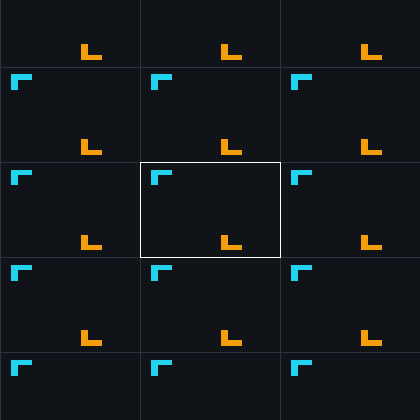
Diagram: teal glyphs are rotations and translations of the original, amber glyphs are its mirror images; the outlined parallelogram is one unit cell. Generated from the same group definition the app classifies with.
pg has glide reflections in one direction and nothing else — no true
mirror, no rotation. Each row of motifs is the mirror image of the row beside it, shifted along by half a
repeat, exactly as a line of footprints has the left print mirrored and stepped forward to give the
right. The orbifold name ×× records two families of glide lines and no other feature.
It is the rarest of the 17 in the built world, and the app's Legendary tier reflects that: designers and bricklayers reach for mirrors and half-turns instinctively, and almost never for a pure glide. Escher used it deliberately — several of his bird and horseman tessellations are pg — which is why most people first meet it in art rather than on a floor.
How to recognize it
- Adjacent rows (or columns) are mirror images of each other, but offset by half a motif — no line gives a clean mirror.
- No point allows a half-turn; every copy of the motif points 'forward' in the same direction.
- Trace the glide: reflect across the line between two rows, then slide — only then do they coincide.
Where you see it
Escher's pg tessellations; some knitted and woven structures; occasionally a running-bond floor laid with a chiral tile. Genuinely hard to find — the collector's trophy.
Easily confused with
- pm — if the facing rows line up without a shift, those are true mirrors — pm.
- pgg — if the pattern also has 2-fold centers, with glides in both directions, it is pgg.
- p1 — an unshifted, unreflected repeat has no glide at all — p1.
The general method: find the highest-order rotation center, then ask about mirrors, then glides — see how to identify a wallpaper group.
See it on your own photos.
Symmetry Hunter identifies the
group from a picture, draws every mirror, glide, and rotation center on it, and keeps score as you
collect all 17 in the wild.