Wallpaper group pm
Parallel mirrors and nothing else.
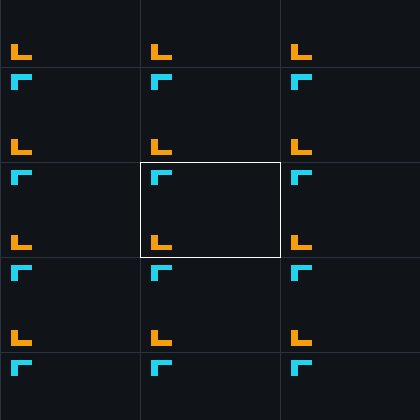
Diagram: teal glyphs are rotations and translations of the original, amber glyphs are its mirror images; the outlined parallelogram is one unit cell. Generated from the same group definition the app classifies with.
pm has mirror lines all running in one direction, and no rotation at
all. There are two inequivalent families of mirrors (hence **), alternating across the pattern;
between any two adjacent mirrors sits one copy of the motif and, across the mirror, its reflection. The
lattice must be rectangular, because a mirror forces the repeat perpendicular to it to be at right angles.
Think of vertical stripes of mirror-symmetric motifs — a column of arches, a band of leaves pointing up — repeated sideways. The motif's own mirror becomes a mirror of the whole pattern; the gap between columns gives the second family.
How to recognize it
- Flip the pattern across a vertical (or horizontal) line through the center of a motif and it lines up; across any other direction it does not.
- No point allows a 180° turn — the stripes have a definite 'up'.
- Mirror images of the motif face each other across the mirror lines; nothing is shifted along them.
Where you see it
Vertical bands of leaves, arches, or figures on fabric and wallpaper; cast-iron railings with a one-way motif; stripes of mirror-symmetric ornament.
Easily confused with
- pg — if the facing copies are shifted by half a repeat along the line, it is a glide, not a mirror — pg.
- cm — if there are also glide lines between the mirrors (the rows are staggered), it is cm.
- pmm — if a second set of mirrors runs perpendicular to the first, it is pmm.
The general method: find the highest-order rotation center, then ask about mirrors, then glides — see how to identify a wallpaper group.
In the wild
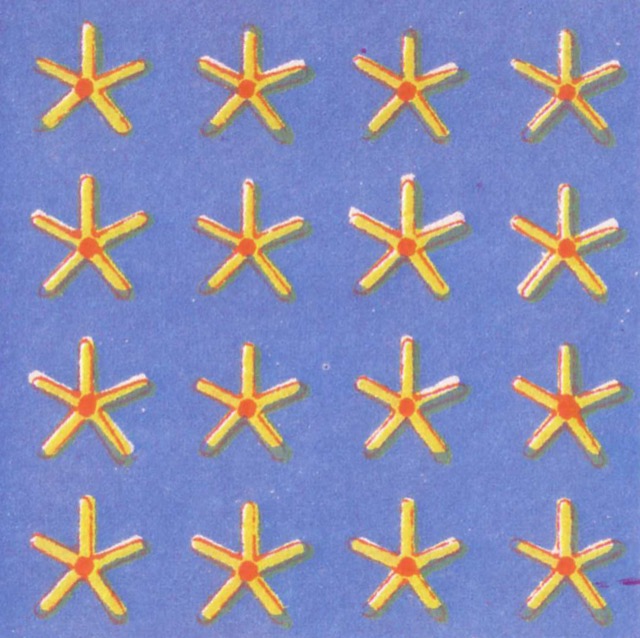
Public-domain plates (Owen Jones, The Grammar of Ornament, 1856, via Wikimedia Commons), each classified by the app's engine to confirm the label.

See it on your own photos.
Symmetry Hunter identifies the
group from a picture, draws every mirror, glide, and rotation center on it, and keeps score as you
collect all 17 in the wild.