Wallpaper group p1
Translations only — the plainest repeat there is.
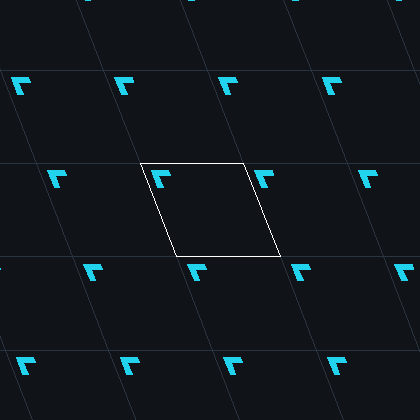
Diagram: teal glyphs are rotations and translations of the original, amber glyphs are its mirror images; the outlined parallelogram is one unit cell. Generated from the same group definition the app classifies with.
p1 is the wallpaper group with no symmetry beyond repetition: slide the pattern along either lattice direction and it lines up with itself, and that is all. No point you can turn it about, no line you can flip it across. Any asymmetric motif — a hand, a letter R, a leaf drawn from one side — stamped out on a lattice gives p1.
Because nothing constrains the lattice, p1 lives on the general oblique lattice: the two repeat vectors can have any lengths and any angle between them. Every other wallpaper group is p1 plus something, which makes it the root of the whole family — and, since real decorative patterns almost always have at least one mirror or a half-turn, surprisingly uncommon in the wild.
How to recognize it
- Find the repeat, then check: no point where a 180° turn lines the pattern up, no mirror line, no glide.
- The motif itself must be asymmetric — if the motif has a mirror, the pattern does too.
- Look at hand-drawn or printed repeats (wrapping paper, novelty fabric): the drawn motif is usually identical in every cell, with no flipped copies.
Where you see it
Printed fabrics and wrapping paper with a single drawn motif; wallpaper with a one-way figurative print; some woven labels.
Easily confused with
- p2 — if a half-turn about some point lines the motif up with itself, it is p2 — the copies look the same but half of them are upside down.
The general method: find the highest-order rotation center, then ask about mirrors, then glides — see how to identify a wallpaper group.
See it on your own photos.
Symmetry Hunter identifies the
group from a picture, draws every mirror, glide, and rotation center on it, and keeps score as you
collect all 17 in the wild.