Wallpaper group p3
Three-fold rotations and nothing else — Escher's lizards.
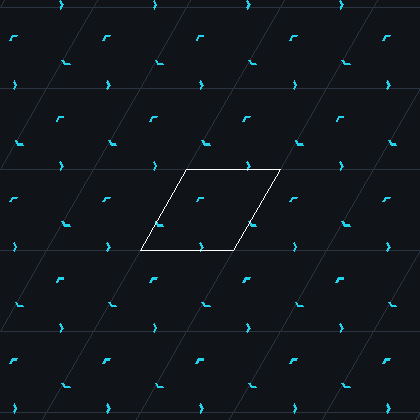
Diagram: teal glyphs are rotations and translations of the original, amber glyphs are its mirror images; the outlined parallelogram is one unit cell. Generated from the same group definition the app classifies with.
p3 has 3-fold rotation centers and no reflections. There are three
inequivalent kinds of center — 333 — at the corners of the hexagonal cell's two triangles and at
the cell's corners. The lattice must be hexagonal (two equal repeat vectors at 60° or 120°).
Patterns are chiral, like p4: three-armed motifs all spinning the same way. It is the least decorative of the hexagonal groups and rare in architecture, but it is the group of some of Escher's most famous tessellations, including the interlocking lizards of Reptiles.
How to recognize it
- A 120° turn lines the pattern up about several kinds of point.
- No mirror line works; the motifs are three-armed and chiral.
- No 60° turn works (that would be p6).
Where you see it
Escher's three-lizard and three-fish tessellations; some triskelion-based textiles; rarely in tile.
Easily confused with
- p3m1 / p31m — if mirrors exist, it is one of the two mirrored 3-fold groups.
- p6 — if a 60° turn works about some point, it is p6.
The general method: find the highest-order rotation center, then ask about mirrors, then glides — see how to identify a wallpaper group.
See it on your own photos.
Symmetry Hunter identifies the
group from a picture, draws every mirror, glide, and rotation center on it, and keeps score as you
collect all 17 in the wild.