Wallpaper group p31m
Three-fold centers, some of them off the mirrors.
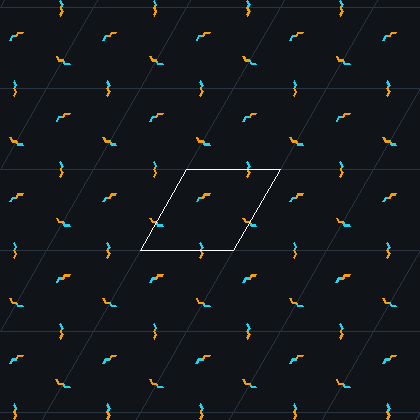
Diagram: teal glyphs are rotations and translations of the original, amber glyphs are its mirror images; the outlined parallelogram is one unit cell. Generated from the same group definition the app classifies with.
p31m also has 3-fold centers and mirrors in three directions, but
here one kind of 3-fold center lies off the mirror lines, floating in the middle of the mirror
triangles — 3*3: a free 3-fold center, then a mirror with one order-3 corner. The mirrors in p31m
run through the lattice points along the lattice directions; in p3m1 they run perpendicular to them.
In practice: find a 3-fold center and ask whether a mirror passes through it. If all do, p3m1; if some do not, p31m. Trefoil and knot patterns in Islamic and Celtic work are often p31m, and several of Owen Jones's plates are, which is why the practice patterns include three of them.
How to recognize it
- 120° turns and mirrors in three directions.
- At least one kind of 3-fold center has no mirror through it — a triskelion-like 'spinner' sitting between mirror lines.
- No 60° turn works.
Where you see it
Trefoil and triple-knot ornament; Celtic and Islamic strapwork on a triangular lattice; several Owen Jones plates.
Easily confused with
- p3m1 — if every 3-fold center is on a mirror, it is p3m1.
- p6m — if a 60° turn works, p6m.
- p3 — no mirrors is p3.
The general method: find the highest-order rotation center, then ask about mirrors, then glides — see how to identify a wallpaper group.
In the wild
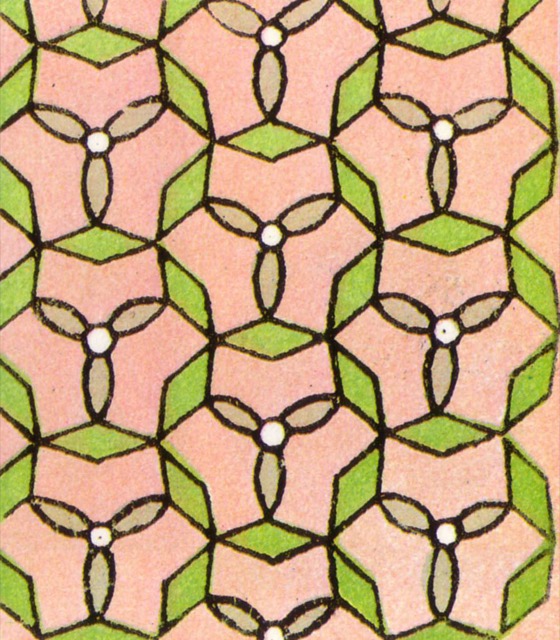
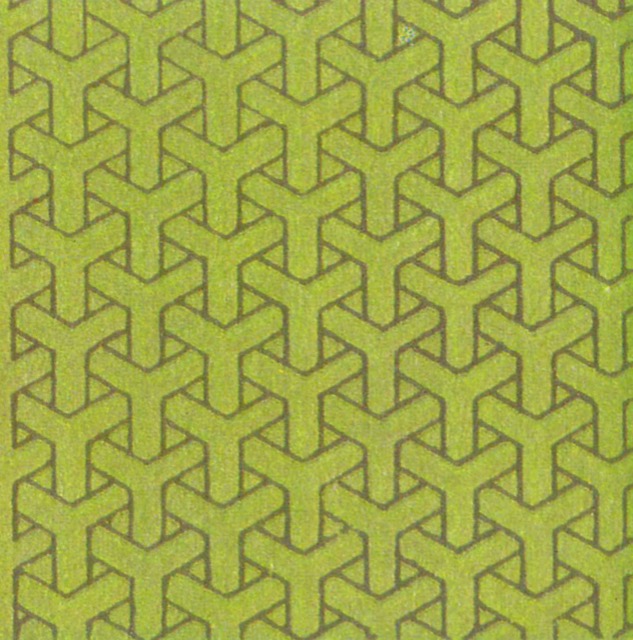
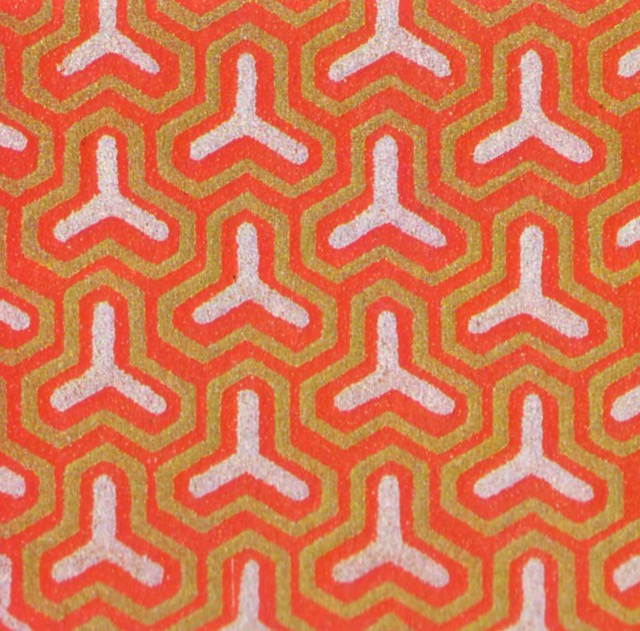
Public-domain plates (Owen Jones, The Grammar of Ornament, 1856, via Wikimedia Commons), each classified by the app's engine to confirm the label.


See it on your own photos.
Symmetry Hunter identifies the
group from a picture, draws every mirror, glide, and rotation center on it, and keeps score as you
collect all 17 in the wild.